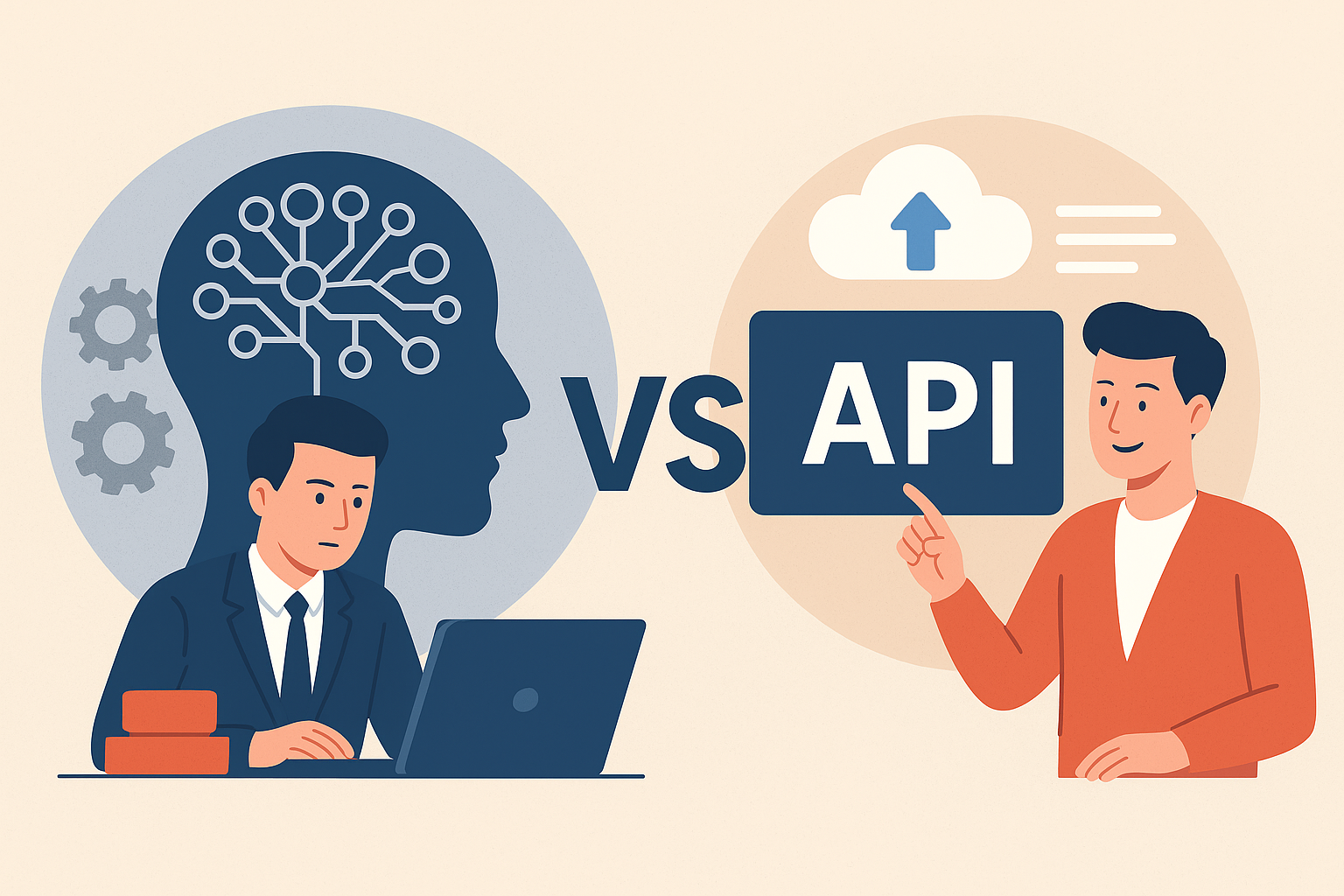
Most companies building AI teams in 2025 are making a $500K mistake.
They’re hiring data scientists and ML engineers because their competitors are doing it, or because their board asked about “our AI strategy” or because it feels like the thing you’re supposed to do.
Unfortunately, the majority of companies building AI teams don’t actually need them.
I’ve spent the last few years working on ML and AI implementations. I’ve seen companies spend six figures on AI infrastructure for problems that could be solved with a $200/month API subscription. I’ve watched teams hire multiple ML engineers to build something Claude or GPT-4 could do out of the box.
And I’ve also seen the 20% who genuinely need to build; the companies where APIs won’t work and building in-house is the only viable option.
The difference? Three specific criteria. Miss even one, and you’re probably wasting money.
The Three Criteria That Justify Building an AI Team
1. Proprietary Data That Legally Cannot Leave Your Infrastructure
This is the big one.
If you’re in healthcare, finance, or defense, you might have data that literally cannot be sent to OpenAI or Anthropic. You might have HIPAA requirements, PCI compliance requirements, or Government security clearances. Some have legal contracts that explicitly prohibit third-party data processing.
That’s a real constraint. APIs won’t work if you can’t send your data to them.
But here’s what doesn’t count as “proprietary data”:
– Customer support tickets (unless they contain PII)
– Marketing content
– Internal documents
– Product descriptions
– Sales data (unless regulated)
Most companies think their data is more sensitive than it actually is. Before you rule out APIs for “data sensitivity,” actually read your compliance requirements. You might be surprised what’s allowed.
2. AI is Your Core Product (Not Just a Feature)
If AI is a feature in your product, use APIs. If AI is your product, build.
AI as a feature:
– Customer support chatbot
– Content recommendations
– Email summarization
– Meeting transcription
– Sentiment analysis
These don’t justify building a team. OpenAI, Anthropic, Google, and others have spent billions building models that do this better than your three-person team ever will.
AI as the product:
– You’re selling AI predictions as the main offering
– Your entire business model depends on model performance
– You’re charging customers based on model accuracy or outcomes
– Competitors can’t easily replicate what you’re building
If customers are paying you specifically for AI capabilities, you need control over the models. If AI is just making your existing product better, rent the capability.
3. High-Volume Inference at Scale
This is a math problem. APIs make sense until you hit a specific volume threshold. Once you’re doing millions of predictions per day, the economics flip.
The break-even point:
– Under 100K API calls/month: APIs are cheaper ($50-$500/month)
– 100K-1M calls/month: APIs still usually cheaper ($500-$5K/month)
– 1M-10M calls/month: Getting close, but APIs might still win ($5K-$50K/month)
– 10M+ calls/month: Building probably makes sense ($50K+/month in API costs)
But volume alone isn’t enough. You also need consistency.
If you’re processing 10 million customer support tickets per month with predictable patterns, building might make sense. If you’re processing 10 million ad-hoc queries with wildly different requirements, APIs are still probably better.
High volume + predictable patterns = consider building.
What Most Companies Are Actually Doing
Here’s what I see most often: a company decides they need “AI capabilities.” They get budget approved for a 3-person AI team: $520K-$700K in Year 1.
Six months later, they’ve built a customer support chatbot that works okay but not great. It took 4 months to build, requires ongoing maintenance, and the total cost is $260K-$350K so far.
The same capability with Claude or GPT-4:
– Costs: $3K-$12K/year depending on volume
– Implementation time: 2-4 weeks
– Maintenance: Minimal (API handles updates)
– Quality: Probably better than what the team built
The delta: $248K-$338K wasted in 6 months.
The Real Cost of Building an AI Team
Let’s be specific about what building actually costs.
Minimum Viable AI Team (3 People)
Year 1 all-in costs:
– Senior ML Engineer: $260K-$355K (salary + benefits + recruiting)
– Data Engineer: $210K-$280K
– ML Infrastructure: $50K-$85K (compute, storage, tools)
– Total: $520K-$720K
Year 2+ ongoing costs:
– Salaries + benefits: $470K-$635K
– Infrastructure: $60K-$120K (scales with usage)
– Retention bonuses: $30K-$60K
– Total: $560K-$815K/year
For a complete breakdown of these costs, see my post on the real cost of building an AI team.
Compare That to APIs
High-volume API usage (realistic for most companies):
– 1M API calls/month at $0.03/call = $30K/month = $360K/year
– Plus engineering time to integrate: $40K-$80K one-time
– Total Year 1: $400K-$440K
But here’s the thing: most companies aren’t doing 1M calls/month.
Typical company API usage:
– 50K-200K calls/month = $1.5K-$6K/month = $18K-$72K/year
– Integration: $20K-$40K one-time
– Total Year 1: $38K-$112K
You’d be saving $400K-$600K in Year 1 by using APIs instead of building.
What to Do If You’ve Already Started Building
Maybe you’re reading this with a sinking feeling. You’ve already hired two ML engineers. You’re six months into building.
Don’t panic, just ask yourself:
– Are we shipping yet? If not, consider switching to APIs to get something in production.
– What’s our API cost would be? Run the math. You might be able to shut down the infrastructure and save $100K+/year.
– Is this actually our competitive advantage? If customers are paying you specifically for AI capabilities, keep building. If AI is just a feature, consider switching.
The sunk cost fallacy is real. Don’t keep spending $600K/year just because you’ve already spent $300K. Cut your losses if APIs make more sense.
Bottom Line
Most companies building AI teams in 2025 don’t need them.
The three criteria are clear:
1. Proprietary data that can’t leave your infrastructure
2. AI as your core product (not a feature)
3. High-volume inference at scale (10M+ predictions/day)
If you’re missing even one, start with APIs. You’ll save $400K-$600K in Year 1, you’ll ship faster, you’ll reduce risk, and when you do need to build, you’ll know exactly what to build.
The question isn’t “should we build an AI team?” The question is “have we proven we need to build yet?”
As much as it pains me to say; for most companies, the answer is no.